Wednesday, May 15, 2013

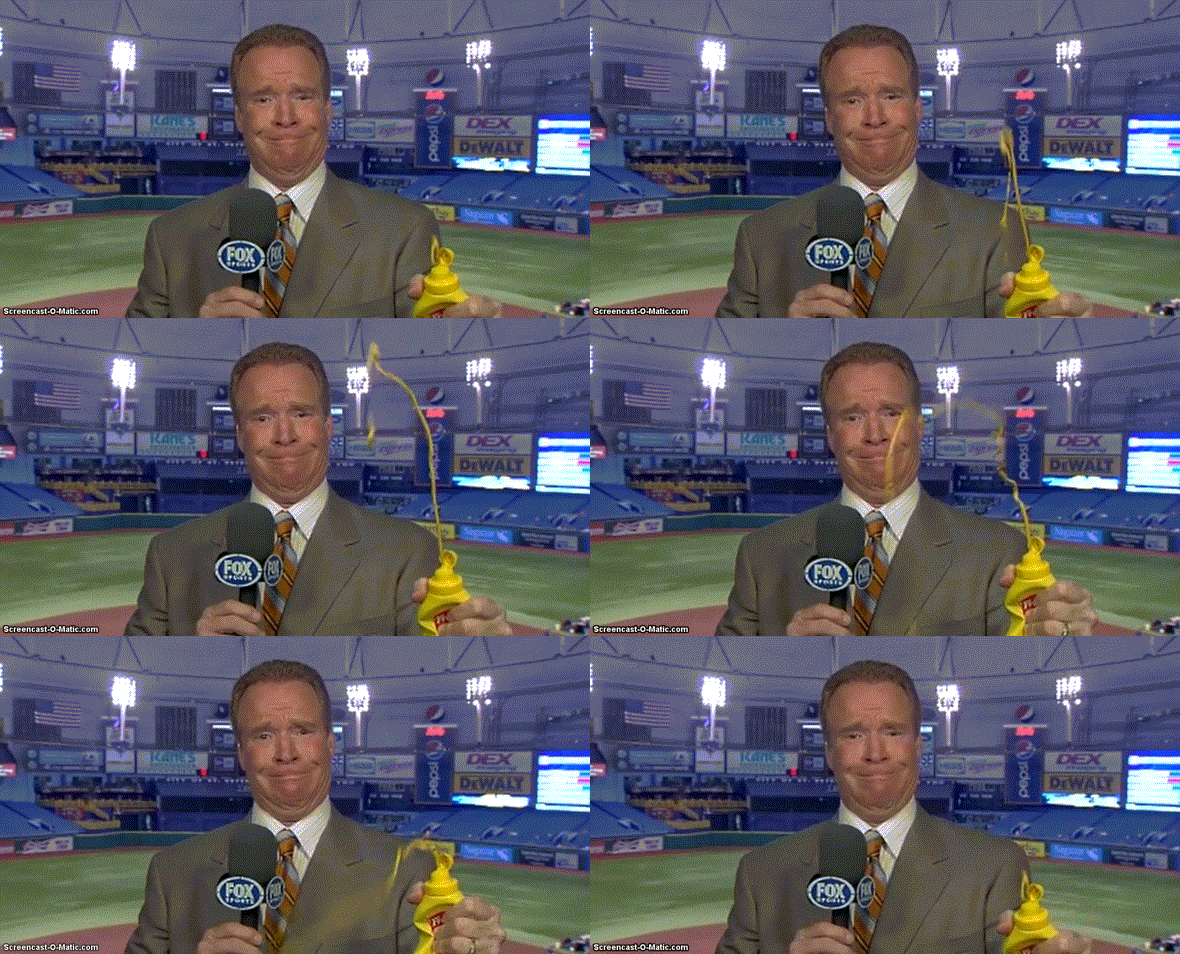
Coming to the Rex-cue: Defending Rex Hudler


Yeah, that title went over about as well as one of Rex’s jokes on the air, but guess what, I don’t care. Rex can make as many failed jokes or awkward statements or five minute long discussions involving a bug being squashed that he wants and I won’t mind it. Let me clarify a little bit: I won’t mind it as much as the sensationalism, venom, and all-around pessimism I see on my twitter timeline every evening the Royals are playing.

“Jeremy Guthrie is still out there. This is as clueless a managerial performance I have ever seen. #Royals”

“This is absolutely unreal. Ned Yost should be fired right this very minute.”

“Oh. My. God. Guthrie is back out for the 7th. We have a freaking idiot managing this team.”

“These two – Hosmer and Moustakas – are cooked. Any replacement would provide roughly the same value.”

These are just a handful of the hundreds of posts that were tweeted last night about the Royals vs Angels game, and there is no end in sight. Never-mind that it’s mid-May and the Royals are currently above .500; if you only followed twitter, then you would think the Royals have had 36 perfect games thrown against them.  Maybe it’s because Royals fans feel like they really have something to lose this season that is making them spew negativity everywhere, or the fact that most of us don’t know what it’s like to see a winner, but regardless, Royals fans far and wide are putting their seemingly endless disdain for anything that resembles a loss, a run given up, or a hit not recorded in 140 characters or less and at a feverish pace.

The thing I hate the most about all of the pessimism is that it’s so dang contagious.  

It’s easy to criticize Ned Yost, or Jeff Francoeur, Chris Getz or Mike Moustakas. It’s easy to write off players as busts. It’s easy to tweet out your every emotion on twitter about the lack of power we have at second, or how dumb it is that Dyson isn’t playing every day. When you see Royals twitterverse doing a collective face-palm every time a runner is thrown out trying to steal or every time we ground out on the first pitch, it’s easy to join in on it. I’ve done it. You’ve done it. But what did it accomplish? Did it make me/you feel better? No.

That’s where Rex Hudler comes in. Does he strike me as an intelligent guy? Nope. Is he the best broadcaster I've ever watched? Not even close. Did I wish that Billy Butler’s 500th RBI had been commemorated with something a little more elegant than “a Billy Bomb with Barbecue sauce!”? Sure. But in all of Hudler’s faults, there is a simple truth: he is nothing if not optimistic.

Genuine optimism: that is what Hudler brings to my television screen during Royals games. I don’t believe it’s fake, and I don’t believe he knows any other way to broadcast. When a guy strikes out, Hud says it was just a really good pitch. When our pitcher gives up a solo shot, Hud makes sure to point out that no one was on base. Hud is exhaustingly positive, but it is the only thing that makes twitter bearable for those three hours. His optimism helps fight the wrist-slitting, we-suck, mentality I can’t help but pull up on my computer screen during games.

Royals fans have more right than most to complain. I understand that. I’m a part of that. But if I had to choose between listening to Hud or reading Royals fan tweets during the games, I would choose Hud. Rex is an oasis of positivism and amusing ignorance in a desert of nonconstructive disapproval and saber metric dry heaving. While venting frustration is a fan’s prerogative, it’s also Hud’s job responsibility pleasure to put the Royals players and coaches in the best light possible. And while it might be annoying every now and then, it’s also comic relief and an excuse to tweet about something other than the Royals’ deficiencies.

Do I believe Rex is an idiot? Absolutely. But I also think that of 85% of the Royals twitterverse. Hud makes the mistakes seem less important, the at-bats less disastrous; and why shouldn't he: we have a winning record!!! And, perhaps most importantly, where would Royals nation be at without Rexisms? So next time you start to think about criticizing Hud, think about this instead:

Can you sneak a piece of cheese by a hungry rat?

Friday, May 10, 2013

Optimizing the Lineup Using The Book

A lot of fuss has been made over the Royals lineup over the past couple of weeks. Personally, I think lineup discussions are often much ado about nothing. Everyone hits and lineup discussions tend to take too much a what have you done for me lately. However, lineup optimization is not without value. In fact, according to The Book; Playing the Percentages in Baseball by Tom Tango, Mitchel Lichtman, and Andrew Dolphin, the perfect lineup could result in upwards of 15 more runs over the course of season. This is not a huge difference but could account for an additional 1 or 2 wins over the course of a season.

Let's simply take a moment to apply The Book's findings to the Royals roster to determine what the most productive lineup would be for Kansas City. Before we get too deep into the application, let's jot down a few important notes on the construction of the lineup:

  • "The wOBA of the #2 and #4 hitters should be about the same."
  • When deciding between these two slots, the player with more extra base hits goes at #4 and the player with more walks at #2.
  • The #2 and #4 spots are more valuable than the #3 spot.
  • The #5 spot gets more value out of singles, doubles, triples, and walks than the #3 spot.
  • The #3 spot gets more out of home runs than the #5 spot. 
  • The #5 spot should feature a better hitter than the #3 spot.
  • Your worst four hitters go in spots #6 through #9 in descending order.
  • The leadoff hitter is similar in value to the #2 and #5 hitters. 
  • The leadoff hitter receives more values from walks and less from home runs.
  • The overall quality of the leadoff hitter should be similar to that of the #2 hitter.
  • #2 hitter's preferred outs are strikeouts. 
  • Clean up hitter' preferred outs are productive.
  • A double play prone hitter's negative affect can be mitigated in the leadoff spot.
I think the first key takeaway, is that the perception that the #3 spot is the most important is simply not true. In fact, the three hole is actually probably the fifth most valuable spot in the order. Are you still a fan of Gordon's new spot?

Now one more point to make before sketching out lineups. This information can be applied in different ways. Unfortunately, pieces don't fit perfectly into the above puzzle so we will just have to do the best we can. Let's get to work on this. 
  1. Eric Hosmer - With three batting order spots being more important than the rest, and only two hitters clearly better than the pack, someone gets put into this role. The leadoff hitter receives more value than the other five spots from singles and walks, but less value from home runs. Eric Hosmer may not be hitting with power, but he is getting on base.
  2. Alex Gordon - There is reason to believe that the second spot in the order is the most important in the lineup. Billy isn't a good fit, due to his propensity of double plays. Strikeouts are the ideal out result in this spot, and that also happens to be Gordon's flaw as a hitter.
  3. Lorenzo Cain - This spot is tough for me. The #5 spot is more valuable, but you also don't want three lefties in a row. For that reason I am putting Cain here. 
  4. Billy Butler - With Gordon hitting second, Butler is perfect in the clean up spot. 
  5. Mike Moustakas - I think Moustakas is heating up. I put him in this spot. 
  6. Salvador Perez - Out of the remaining options, he is clearly the best hitter.
  7. Jarrod Dyson/ Jeff Francoeur
  8. Alcides Escobar
  9. Elliot Johnson/Chris Getz
Another option could be:
  1. Alex Gordon
  2. Lorenzo Cain
  3. Mike Moustakas
  4. Billy Butler
  5. Eric Hosmer
  6. Salvador Perez
  7. Jarrod Dyson/Jeff Francoeur
  8. Alcides Escobar
  9. Elliot Johnson/Chris Getz
Ultimately, there are justifications for moving guys around quite a bit and this is what makes lineup creation so hard. If there was a simple formula, it would be easy to point and give an answer. Based off The Book's findings, here are a few takeaways when applied to the Royals:

  • Neither Gordon or Butler should be seeing time in the much overvalued three slot.
  • Billy Butler shouldn't hit second either due to that spot's susceptibility to double plays.
  • Alcides Escobar doesn't get on base enough to justify hitting leadoff. 
I'm not saying that either of these lineups are the answer. Again, I don't think there is much additional value provided even my an optimum lineup. Alex Gordon in the #3 spot has worked out for the last two games, but over the course of an entire season, the analytics state the Royals will lose value with him in that spot. Hopefully, the lineup starts to hit and we all can stop suggesting lineup changes as a means to fix the offense.

Wednesday, May 8, 2013

Prospect Crush: Miguel Almonte


After a tedious but informative (for myself at least) look at the top 30 prospects in the Royals system, I found myself very excited about the upside of Miguel Almonte.  This is despite the fact that coming into the season Almonte had all of 88 professional innings over the past two years.  Almonte has continued to impress coming into the season, making the jump from rookie to A ball seem easy over his first six starts.  Almonte has continued to display good control (2.93 BB/9) and the ability to strike out batters (8.51 K/9).  His 3.82 ERA and 3.23 FIP are impressive for a young man who turned just 20 years old a month ago. 

Almonte’s May 1st performance in which he allowed just one hit and struck out nine over 6 innings netted him a spot on the May 3rd edition of Baseball America’s Hot Sheet.  He followed up on that start nicely yesterday, throwing 6.1 innings while allowing only one run and netting seven strike outs.  The right handed Almonte is commanding his fastball that can hit 96 on the radar but usually sits at 92-93, and is said to have a plus changeup.  He has plenty of time to work on refining his secondary pitches, as he has youth on his side. 

There is a lot to like in Almonte.  For example, judging by his Hot Sheet photo it seems that the youthful Almonte has decided to try his luck with a mustache.  That’s the kind of bold decision I like to see from a promising prospect.  On an actual baseball note, he already has two plus pitches and a superb command as he allowed only 13 walks in 77 innings last season.  Even though it is somewhat pointless to compare him to a player that has never seen the majors, it does seem like he could be the Royals 2013 version of Yordano Ventura.  While they certainly have a different skill set, there is a clear correlation in terms of success+age+level.  Speaking of Ventura, the 21 year old righty has decided that the jump to AA is not at all difficult, as he has dominated over his first 30 innings for Northwest Arkansas.  Ventura is in the top five in ERA (1.83) and strike-outs (43) in the Texas League.  While any long time Royal fan has to be jaded by the lack of success from high profile pitching prospects over the last several years, these two arms just may be a cure for this cynicism.  

Identifying Luke Hochevar's role moving forward


Coming into the season the Kansas City Royal’s bullpen was supposed to be a strongpoint of the team.  With Greg Holland pitching decent but not great and Kelvin Herrera having major home run issues (3.77 HR/9), there could be some major shake-ups among the bullpen as we move into to the summer.  While arms like Aaron Crow and to a lesser extent Tim Collins bring some intrigue, I find myself thinking that there is legitimate hope for Luke Hochevar to become a major impact in the pen for a team in the Royals who cannot afford to lose games late if they hope to be a playoff contender. 

On the surface Hochevar, who is making 4.65 million dollars this season, has been impressive in the early going, posting a 0.79 ERA with 12 K’s over his first 8 appearances (11.1 IP).  While this is obviously a very small sample, Hoch does appear to be a different pitcher than he was as a starter for the past five years.   While you should expect an increase in velocity, Hochevar have displayed an impressive increase of velocity of almost 2 MPH difference, throwing his heater at 94.5 MPH.  He has also increased velocity and usage of his cutter while essentially dropping his slider from his repertoire.  His fastball has been effective this year, which may be part of the reason that he has shown good command thus far, allowing only three walks during the first month. 

Beyond velocity, the second biggest change that I noticed was his severe drop in ground ball rate.  While a) this is not necessarily a good thing and b) there is a major small sample caveat to go with this rate; Hochevar can sacrifice ground balls if he continues to strike people out and limit home runs.  Hochevar has only given up one home run thus far this season, allowing Alexei Ramirez to go deep on opening day.  Another reason I am less concerned about his miniscule 29.3% ground ball rate is his unsustainable but still impressive 23.1% infield fly rate.  This means that Hoch is either striking out or inducing an infield fly to half of the batters he faces, and as far as I am concerned these are equally successful outcomes as base runners will not advance on either result.  This insane infield fly rate can also help explain his 100% LOB% as well as his low .222 BABIP (his career BABIP is .302) as something other than plain luck.

While it may be foolish to trust Hochevar as a reliever moving forward I find myself convinced that it is possible.  Ned Yost has said that Hochevar or Crow could see save chances on days that Greg Holland is unavailable, and I could see the Royals trusting a guy like Hochevar in some high leverage situations down the road in what the Royals hope is a very exciting season.  In fact, it would not shock me to see Hochevar manning the closer role at some point, especially if Holland and Herrera show that they are not suited for that role this year. 

Monday, May 6, 2013

New Rotation Arrivals and Early Success

Even after today’s loss against the Chicago White Sox, the Royals have had a great start of the season compiling a 17-11 record.  One of the major reasons for the shiny record is the arrival of Ervin Santana and Jeremy Guthrie.  The two combine for a 7-1 record and have stabilized a rotation desperate for consistency.  So what should Royals fans expect from these two for the rest of the season?

Jeremy Guthrie:
Jeremy Guthrie has been a very productive pitcher since getting traded for Jonathan Sanchez in a welcome move away from Coors Field.  A solid second half netted him a 3yr/25 million dollar deal with Kansas City this offseason (which I admittedly was not a fan of, but I was a fan of the Joe Blanton signing, so I clearly have some issues).  So far Jeremy Guthrie has provided six solid starts to begin the year compiling 4 wins and a shiny 2.40 ERA.  His 1.11 WHIP is down from his career mark of 1.30 and he is inducing ground balls at his best rate since 2006.  Pitch/FX data tells me that he is throwing more sinkers this season, which may be part of his rising ground ball rate.  He is also a horse in present day terms, averaging nearly 7 innings per start, which is important to a team with surprising problems in their bullpen. 

Of course fans have to expect general regression, but what are Guthrie’s warning signs?  The first number that jumped out at me was his 93.3 LOB%. The average left on base percentage for pitchers is generally around 70-72%, wich Guthrie’s sitting at 73% for his career.  While pitchers can leave an uncanny number of runners left on base, this number should regress closer to the mean as the season rolls on.  While Guthrie displays good control issuing 11 walks in his first 41 innings, his control is not elite, and he will likely never be more than a slightly below average pitcher in terms of strikeouts.  Lastly, Guthrie has allowed 6 home runs during his first six starts, and I think it is fair to expect him to continue to give up the long ball throughout the season.  Assuming he starts 30+ times, he will probably give up around the same number of homers.

The 34 year old Guthrie should certainly prove to be worth his 2013 salary as he should continue to be a workhorse who has proven durable over the course of his career.  I do not think that this will be a renaissance year for Guthrie, however.  He doesn’t seem to be doing anything significantly different or better than any other year skill wise, and I would expect his ERA to wind up closer to his 4.47 current FIP than a sub 4 showing by year end. 

Ervin Santana
Ervin Santana came over to the Royals in a trade last winter, but I look at it more as a 1 year 12 million dollar contract from the Royals perspective, as they traded a prospect unlikely to ever reach the majors and somewhat surprisingly agreed to pay Santana twelve of the thirteen million dollars that he is owed.  Santana, like Guthrie, has made the Royals look smart during the first month of the season.  Santana’s ERA sits at an even 2.00, with similarly impressive 3.24 and 3.23 FIP and xFIP, respectively.  His 6.2 K/BB is good for sixth best in the entire major leagues.  Because of his microscopic BB% and WHIP, Santana has been able to average over 7 innings per start.  One of the biggest differences is home runs.  Santana will always give up a decent amount of homers, but he has not surprisingly cut his homeruns allowed almost in half after giving up nearly 2 homeruns per nine in 2012.

What else is he doing different from last year?  First of all, his fastball has been much more productive.  I am not sure if he is throwing his fastball any differently, but it certainly doesn’t rank as the worst fastball in baseball as it did last season.  He is throwing it at the same MPH of 91.7, but it hasn’t been nearly as volatile as it were last year.  Santana is hardly walking anyone, but during his ‘good’ years he has displayed good control.  While it won’t last at this pace he should maintain good control.  While is walk rate would rank as the best of his career, his strikeout rate of 7.74 would rank as his best since 2008.  His average K/9 over the past four years is just under four, but I don’t think it is out of the realm of possibility that he is able to maintain is K-rate and keep it around 7.5+ for the entire season.

What am I worried about going forward? Like Guthrie, I worry about his 89% LOB%.  Some of these runs are eventually going to score, but no one is expecting Santana’s ERA to stay at 2.00.  His batted balls are consistent with his career norms and his home runs have stabilized compared to a horrid 2012.  I do expect Santana to continue to give up home runs, however, and he could push the 30+ home run mark over 30 starts, even if he is aided by home ball park and pitching against the AL Central.  

To me, Santana’s success depends on his K/BB.  If he can maintain a top ten ratio in the game, we could see a pitcher providing tons of innings and an ERA around 3.50.  If they return to what he produced in recent history, we could see his ERA spike somewhere between the high 3 ERA's he posted in 2010 & 2011 and his ERA that hovered over 5 in 2009 and 2012.  I would suspect it to be closer to his 2010/11 numbers.  Santana is a streaky pitcher, which also could give pessimists reason to be concerned, but overall Royals fans should be very excited with what Santana has shown them to start the year.